Maria Temple
Maria Temple, the superintendent of Lowood Institution, stands as a figure of serene authority and moral clarity in the grim landscape of Jane Eyre's childhood. She is the first adult in the novel to offer Jane unconditional respect and justice, functioning as a surrogate mother, a rigorous educator, and a quiet but effective counterforce to the institutional cruelty of Mr. Brocklehurst. Her influence shapes Jane's character during eight formative years, and her eventual departure precipitates Jane's restless desire for a life beyond the school's walls.
Identity and Introduction
Miss Temple is introduced through Jane's awestruck eyes on her first full day at Lowood. She is described as "tall, fair, and shapely," with "brown eyes with a benignant light" and a "stately air and carriage" . Her full name, Maria Temple, is discovered by Jane on a prayer-book entrusted to her to carry to church . Unlike the other teachers—the coarse Miss Smith, the fierce Miss Scatcherd, and the harsh, grotesque Madame Pierrot—Miss Temple commands immediate respect and admiration. She is the superintendent, but her authority is not merely institutional; it is rooted in a palpable goodness and intelligence that Jane, starved for affection and fairness, instinctively recognizes and venerates.
Role as Mentor and Protector
Miss Temple's role as Jane's protector is most dramatically displayed during Mr. Brocklehurst's public denunciation of Jane as a liar. After the humiliating ordeal on the stool, Miss Temple does not abandon Jane. Instead, she invites Jane and Helen Burns to her room for tea, offering not only physical sustenance—a seed-cake she produces from a locked drawer to supplement the meager toast —but also a patient, fair hearing. She tells Jane, "when a criminal is accused, he is always allowed to speak in his own defence" , and listens to Jane's story of her miserable childhood at Gateshead. She then writes to Mr. Lloyd, the apothecary, to corroborate Jane's account . When his reply confirms Jane's truthfulness, Miss Temple assembles the whole school and publicly clears Jane of every imputation . This act of justice is a turning point in Jane's life, restoring her self-respect and cementing her loyalty to Lowood.
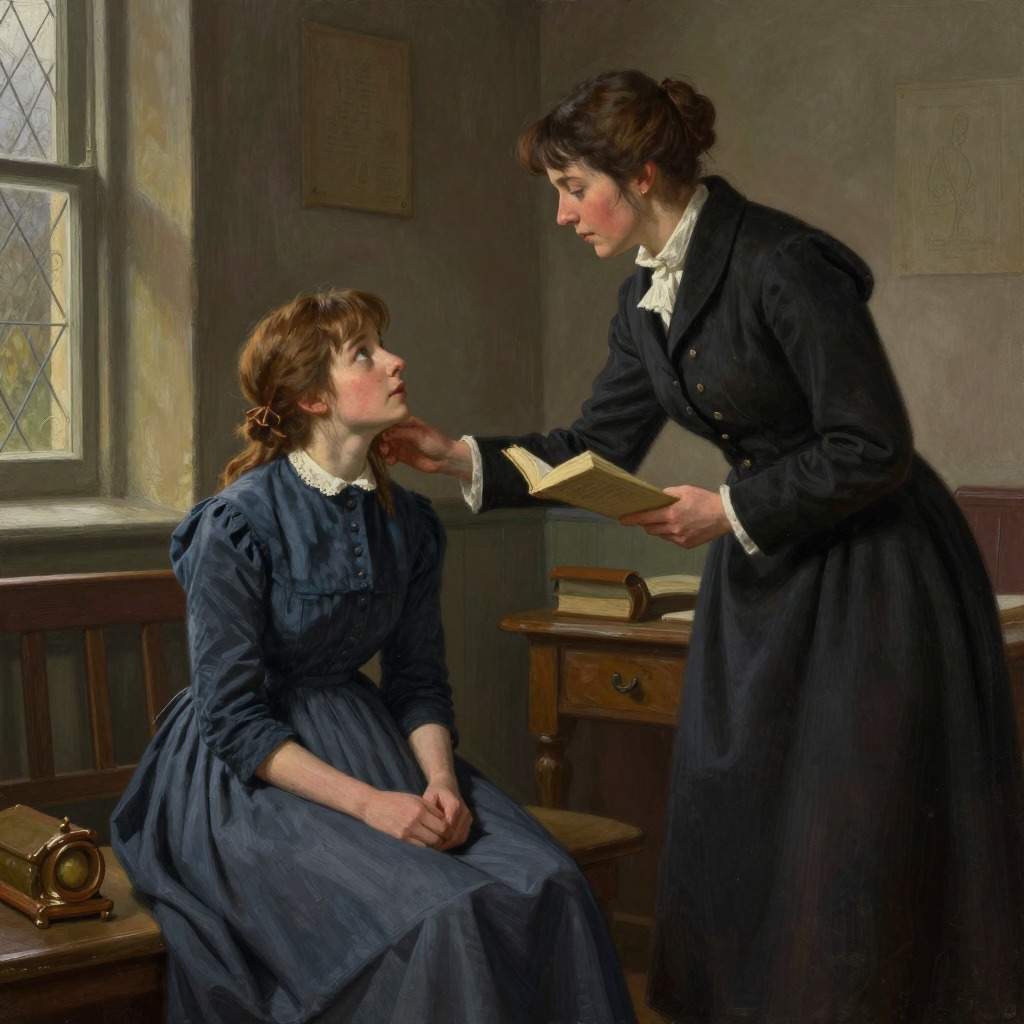
Her protection extends beyond Jane. She quietly subverts Mr. Brocklehurst's harsh policies, such as when she orders a lunch of bread and cheese after a breakfast of inedible burnt porridge, taking the responsibility upon herself . She also defends the natural curls of Julia Severn against Brocklehurst's demand that they be cut off, though her remonstrance is overruled . In her interactions with Helen Burns, she shows a tender concern for the dying girl's health, examining her pulse and sighing sadly , and she keeps Helen in her own room during her final illness .
Relationship with Jane and Helen Burns
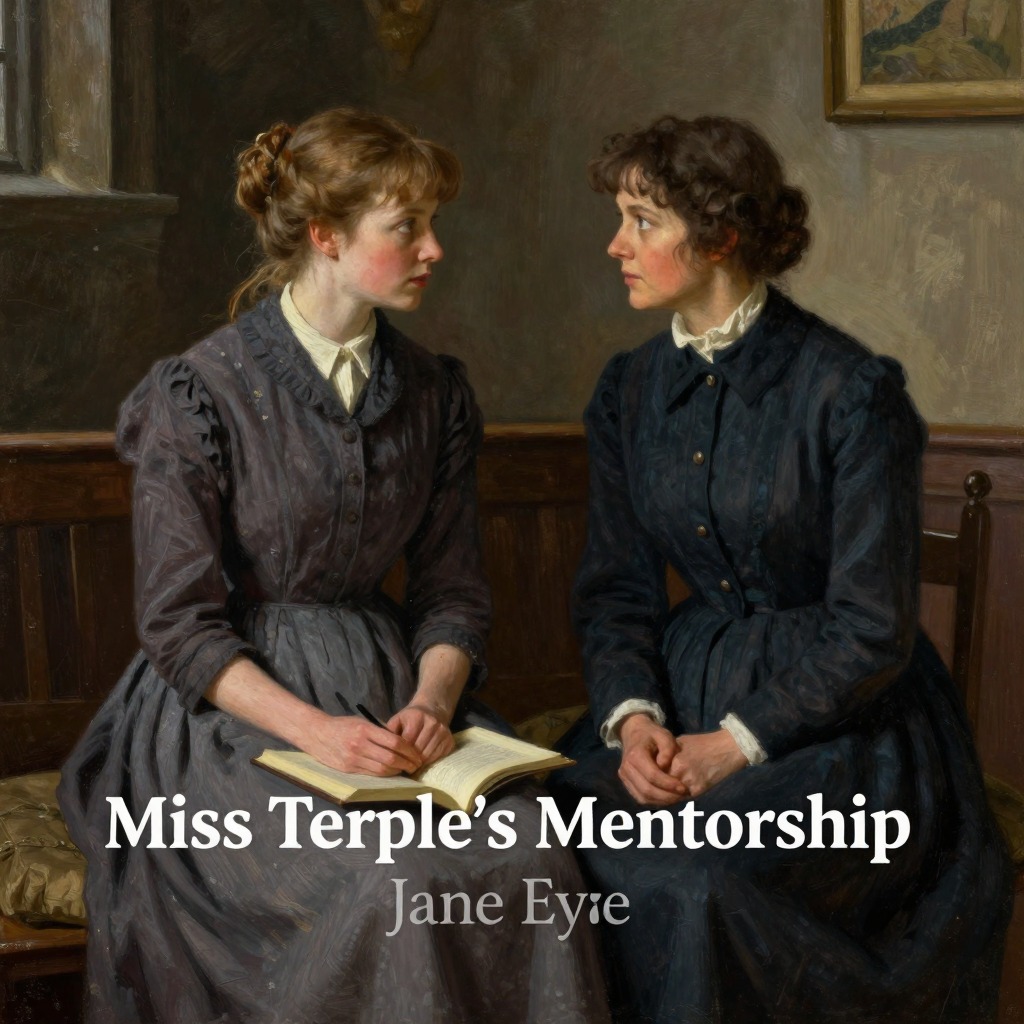
The evening in Miss Temple's room is a seminal moment for both Jane and Helen. Miss Temple creates a space of intellectual and emotional freedom, conversing with Helen about books, nations, and even Latin, which Helen reads from a page of Virgil . Jane, listening, feels her "organ of veneration expanding" . This scene reveals Miss Temple's unique gift: she treats her pupils as intellectual equals, fostering their minds rather than merely disciplining them. For Jane, Miss Temple becomes "the mother, governess, and, latterly, companion" , a source of solace and the model of a harmonious, disciplined character. Jane admits that she "had imbibed from her something of her nature and much of her habits: more harmonious thoughts: what seemed better regulated feelings had become the inmates of my mind" .
Departure and Aftermath
Miss Temple's marriage to the Reverend Mr. Nasmyth and her subsequent removal to a distant county marks a profound rupture in Jane's life . Jane watches her step into a post-chaise and disappear over the hill, then retires to her room, where she realizes that "with her was gone every settled feeling, every association that had made Lowood in some degree a home to me" . The departure strips away the borrowed serenity Jane had worn, leaving her in her "natural element" and stirring the old, restless emotions . It is this loss that directly prompts Jane to look beyond the "prison-ground" of Lowood's horizon and to seek a new servitude in the wider world . Miss Temple's influence, therefore, is not only formative but catalytic: her absence creates the vacuum that propels Jane toward Thornfield and her destiny.
Thematic Significance
Maria Temple embodies the possibility of a just and nurturing authority within a corrupt system. She is the living refutation of Mr. Brocklehurst's doctrine that deprivation and humiliation are the proper tools for shaping Christian character. Her quiet, principled resistance—providing food when children are starving, demanding evidence before condemning a child, and treating her charges with intellectual respect—demonstrates that institutional reform is possible through individual integrity. She represents the "better regulated feelings" that Jane internalizes, but she also represents a settled, domestic contentment that Jane ultimately cannot share. Miss Temple's marriage and departure signal that Jane's path lies not in replicating her mentor's life but in using the moral and intellectual foundation Miss Temple provided to forge her own, more turbulent and passionate destiny.